
Canadian Registration Number: What Manufacturers Need to Know
For companies supplying pressure equipment into Canada, understanding the Canadian Registration Number process is an important part of project planning. Whether you manufacture pressure vessels, piping systems, fittings, or heat exchangers, registration requirements can directly affect approvals, schedules, and installation readiness.
Many organizations outside Canada first encounter CRN requirements when preparing equipment for industrial facilities, energy projects, or manufacturing operations. While the process can appear technical, the purpose is straightforward. A Canadian Registration Number helps confirm that pressure equipment designs meet applicable regulatory and code requirements before use within a Canadian jurisdiction.
What Is a Canadian Registration Number?
A Canadian Registration Number, commonly called a CRN, is a registration identifier issued by a provincial or territorial authority in Canada for pressure equipment designs.
The CRN system applies to many types of pressure-retaining equipment, including:
- Pressure vessels
- Boilers
- Heat exchangers
- Pressure piping systems
- Valves and fittings
- Expansion tanks and related components
The registration process helps authorities review whether a design complies with applicable codes and safety requirements.
Why a Canadian Registration Number Matters
Required for Many Canadian Projects
In many cases, pressure equipment cannot legally be installed or operated in Canada without proper registration. Requirements vary by province and by equipment type, so it is important to confirm the applicable rules early in the project.
Supports Code Compliance
CRN applications are typically reviewed against recognized standards such as ASME codes and relevant provincial regulations.
The review process helps confirm that calculations, materials, and design details align with applicable requirements.
Helps Avoid Delays
Registration issues can affect manufacturing schedules, delivery timelines, and project startup dates. Early planning and complete documentation often help reduce approval delays.
Builds Confidence with Clients and Regulators
Canadian facility owners and EPC companies generally expect suppliers to understand CRN obligations and provide organized engineering documentation.
Who Typically Needs a Canadian Registration Number?
A Canadian Registration Number may be required for:
- Manufacturers exporting equipment into Canada
- Fabricators producing pressure-retaining systems
- Companies modifying existing registered designs
- EPC contractors managing industrial projects
- Plant owners installing new pressure equipment
International companies often require additional support because Canadian registration procedures may differ from those used in other countries.
The Canadian Registration Number Process
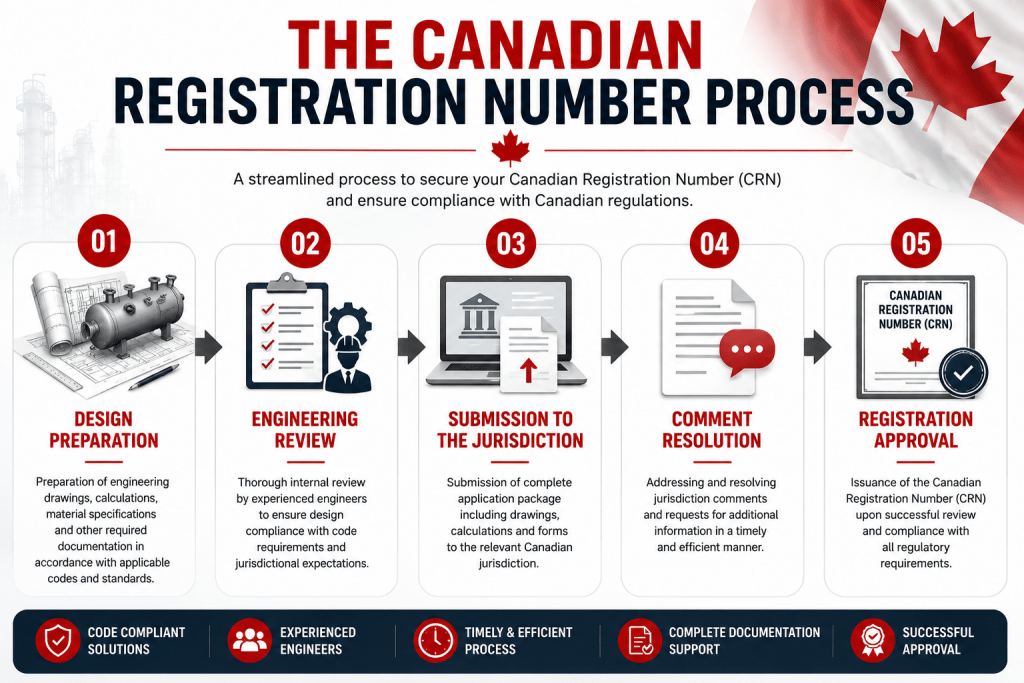 While each jurisdiction has its own review procedures, the process generally includes several key steps.
Design Preparation
Engineering drawings, calculations, material specifications, and code references are assembled for review.
Engineering Review
The design package is checked for compliance with applicable standards and pressure equipment regulations.
Submission to the Jurisdiction
Applications are submitted to the relevant provincial or territorial regulator.
Comment Resolution
Authorities may request clarifications or revisions before granting approval.
Registration Approval
Once accepted, the design receives its CRN registration identifier.
Common Challenges with CRN Applications
Many registration delays are caused by documentation gaps rather than major engineering problems. Common issues include:
- Incomplete calculations
- Drawing inconsistencies
- Incorrect code references
- Missing material information
- Unclear pressure boundary definitions
- Jurisdiction-specific formatting requirements
Because provincial expectations can differ, experience with multi-jurisdiction submissions is often valuable.
Canadian Registration Number Requirements Across Provinces
Canada does not use a single national approval authority for pressure equipment registration. Each province and territory administers its own process through the applicable regulator.
For example, one jurisdiction may request additional supporting documents while another may have different review timelines or submission requirements.
Local regulations always apply, and project requirements should be confirmed for the intended installation location.
How MECS Supports Canadian Registration Number Projects
MECS provides practical engineering support for Canadian Registration Number applications across multiple industries.
Our services include:
- Pressure vessel and piping calculations
- CRN application preparation
- Design review and compliance assessments
- Drawing updates and documentation support
- Multi-province registration strategies
- Professional Engineer review where required
- Coordination with fabricators and project teams
Why Engineering Support Makes a Difference
The CRN process involves both technical engineering review and regulatory coordination. Working with experienced professionals can help identify issues early, improve documentation quality, and reduce unnecessary revisions.
For manufacturers entering the Canadian market, this can support smoother project execution and more predictable timelines.
Conclusion
A Canadian Registration Number is an important requirement for many pressure equipment projects in Canada. Proper registration helps support compliance, reduce approval delays, and improve confidence with regulators and project stakeholders.
MECS provides engineering and CRN support services for clients in Canada, the USA, and international markets. If your project requires pressure equipment registration or related engineering assistance, our team is ready to help.
