
P.Eng. Stamping for Pressure Equipment Projects: What Manufacturers and Engineering Teams Need to Know
In pressure equipment and industrial piping projects, engineering documentation is more than a technical formality. Design calculations, drawings, stress analysis reports, and code compliance documents often require review and authentication by a licensed Professional Engineer before they can be submitted to clients, authorities, or provincial regulators.
For organizations involved in pressure vessels, piping systems, process plants, or CRN registration, understanding how P.Eng. stamping works are an important part of project planning and regulatory compliance.
This article explains what P.Eng. stamping is, where it is commonly required, and how engineering firms support manufacturers, EPC contractors, and plant operators through the process.
What Is P.Eng. Stamping?
A P.Eng. stamp refers to the professional authentication of engineering work by a licensed Professional Engineer (P.Eng.). In Canada, Professional Engineers are regulated at the provincial level, and licensing requirements vary between jurisdictions.
When an engineer applies their professional seal and signature to engineering documents, they are confirming that:
- The work has been reviewed under their professional responsibility
- The engineering complies with applicable codes and standards
- The design is suitable for its intended use within the defined scope
- Appropriate engineering judgment has been exercised
For pressure equipment projects, stamped documentation may include:
- Pressure vessel design calculations
- Piping stress analysis reports
- Finite Element Analysis (FEA) reports
- Fabrication drawings
- CRN submission packages
- Structural support calculations
- Engineering design reviews
- Inspection and compliance documentation
P.Eng. stamping is commonly associated with regulatory submissions, owner requirements, insurance compliance, and third-party engineering verification.
Why P.Eng. Stamping Matters in Pressure Equipment Projects
In industries such as oil and gas, petrochemical, power generation, chemical processing, and manufacturing, pressure equipment failures can create significant operational and safety risks.
Engineering review and authentication help establish confidence that systems have been designed according to recognized engineering practices and applicable codes.
A professionally reviewed design can also help organizations:
- Support CRN registration applications
- Demonstrate code compliance
- Meet client engineering specifications
- Reduce delays during regulatory review
- Improve documentation quality
- Address technical issues before fabrication or installation
For many projects, stamped engineering documentation becomes part of the official project record and may be reviewed by regulators, inspectors, clients, or authorized inspection agencies.
Where P.Eng. Stamping Is Commonly Required
Requirements depend on the project scope, equipment type, province, client specifications, and applicable regulations. In practice, P.Eng. authentication is frequently requested for:
Pressure Vessel Design
Pressure vessel calculations prepared to ASME Section VIII requirements are often reviewed and stamped before submission for CRN registration or client approval.
Typical examples include:
- Horizontal pressure vessels
- Vertical separators
- Heat exchangers
- Storage vessels
- Custom fabricated pressure equipment
Piping System Design and Stress Analysis
Industrial piping systems exposed to thermal expansion, vibration, pressure loading, or external forces may require engineering review and stress analysis.
Stamped reports may include:
- Caesar II stress analysis
- Pipe support calculations
- Flexibility analysis
- Sustained and expansion load evaluations
- Nozzle load verification
CRN Registration Packages
Canadian Registration Number (CRN) submissions often require professionally prepared or reviewed documentation, depending on provincial requirements and project conditions.
This may include:
- Design calculations
- Data reports
- Drawings
- Material specifications
- Code compliance documentation
Because CRN processes vary between provinces, applicants should verify requirements with the applicable authority having jurisdiction.
Understanding Provincial Requirements
Engineering regulation and pressure equipment registration in Canada are administered provincially. Requirements can differ between jurisdictions, particularly regarding authentication expectations, submission procedures, and accepted documentation.
Organizations commonly encounter regulators such as:
- Alberta Boilers Safety Association (ABSA)
- Technical Standards and Safety Authority (TSSA)
- Technical Safety BC
- Régie du bâtiment du Québec (RBQ)
Project teams working across multiple provinces should ensure that submissions align with the requirements of each jurisdiction.
For international manufacturers supplying equipment into Canada, this is often one of the more challenging aspects of the CRN process.
Common Challenges in P.Eng. Stamping and Compliance Review
Incomplete Design Documentation
One of the most common issues during engineering review is incomplete supporting documentation.
Examples include:
- Missing material traceability
- Incomplete nozzle load information
- Unverified external loads
- Missing code references
- Inconsistent drawing revisions
These issues can delay CRN submissions and increase review cycles.
Misalignment Between Design Codes and Project Requirements
Projects sometimes combine multiple standards, client specifications, and jurisdictional requirements. Without careful coordination, this can create conflicts between:
- ASME code requirements
- Provincial expectations
- Owner specifications
- International design standards
Early engineering review helps identify these issues before fabrication begins.
Piping Flexibility and Thermal Expansion Concerns
Thermal expansion remains a common source of piping design problems. Systems that appear acceptable in layout drawings may experience excessive loads, nozzle stress, or support issues during operation.
Professional stress analysis and engineering review can help identify:
- Excessive displacement
- High nozzle loads
- Support overload conditions
- Expansion joint concerns
- Fatigue-related risks
The Role of Third-Party Engineering Verification
Independent engineering review is commonly used when:
- Manufacturers require Canadian compliance support
- Owners want additional technical verification
- EPC contractors need stamped calculations
- International suppliers are unfamiliar with CRN requirements
- Existing systems require reassessment or modification
Third-party engineering firms may provide services such as:
- Pressure vessel calculations
- Piping stress analysis
- FEA review
- CRN preparation support
- Professional engineering authentication
- Code compliance assessments
This type of support can help organizations streamline regulatory review and improve overall documentation quality.
How MECS Supports Pressure Equipment Compliance Projects
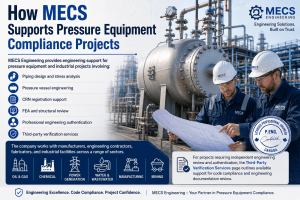 MECS Engineering provides engineering support for pressure equipment and industrial projects involving:
- Piping design and stress analysis
- Pressure vessel engineering
- CRN registration support
- FEA and structural review
- Professional engineering authentication
- Third-party verification services
The company works with manufacturers, engineering contractors, fabricators, and industrial facilities across a range of sectors.
For projects requiring independent engineering review and authentication, the Third-Party Verification Services page outlines available support for code compliance and engineering documentation review.
Best Practices Before Submitting Documents for P.Eng. Review
To improve review efficiency and reduce revision cycles, project teams should prepare:
Complete Design Inputs
Ensure that all operating conditions, design temperatures, pressures, and external loads are clearly defined before calculations begin.
Updated Drawings and Revisions
Drawings should match the latest calculation packages and fabrication details.
Applicable Code References
Clearly identify which editions of ASME, CSA, or other applicable standards are being used.
Supporting Calculations
Where required, include:
- Nozzle load calculations
- Wind and seismic data
- Support calculations
- FEA reports
- Material specifications
Clear Scope Definition
Professional Engineers typically authenticate work within a defined engineering scope. Clarifying responsibilities early helps avoid confusion during submission and approval stages.
Conclusion
P.Eng. stamping plays an important role in pressure equipment projects involving regulatory compliance, CRN registration, and industrial engineering review.
For manufacturers, EPC firms, and plant operators, professionally reviewed engineering documentation can help improve submission quality, reduce delays, and support compliance with applicable codes and provincial requirements.
Because engineering and regulatory requirements can vary by jurisdiction and project scope, organizations should work with qualified engineering professionals familiar with the applicable standards, provincial expectations, and pressure equipment review processes.
