
When Do You Need a Piping Stress Analysis? Real-World Scenarios
Piping systems in industrial facilities are exposed to various operating conditions, including pressure, temperature changes, vibration, equipment movement, and external loads. While piping may appear simple, it plays a critical role in plant safety, reliability, and regulatory compliance.
For companies involved in Piping Canada projects, piping stress analysis helps identify potential design issues before installation, reducing the risk of costly modifications and operational failures.
What Is Piping Stress Analysis?
Piping stress analysis is an engineering evaluation used to determine whether a piping system can safely withstand the loads it will experience during operation.
The analysis typically considers:
Internal pressure
Thermal expansion and contraction
Dead weight loads
Equipment displacement
Wind and seismic forces
Vibration and dynamic loads
Relief valve discharge forces
The goal is to ensure the system complies with applicable standards such as ASME B31.1, ASME B31.3, CSA requirements, and relevant Canadian regulations.
Why Is Piping Stress Analysis Important?
A piping system that meets basic design requirements may still experience excessive stress during operation. Without proper analysis, facilities can face problems such as:
Equipment nozzle overload
Pipe support failures
Excessive vibration
Leaks and fatigue cracking
Thermal expansion damage
Increased maintenance costs
Compliance concerns
Conducting stress analysis early in the project helps improve safety, reliability, and long-term performance.
Common Scenarios Where Stress Analysis Is Required
High-Temperature Piping Systems
Steam, hot oil, and other elevated-temperature systems expand as temperatures rise. Stress analysis helps verify that thermal growth can be accommodated without damaging equipment or supports.
Critical Equipment Connections
Piping connected to pumps, compressors, turbines, heat exchangers, and pressure vessels often requires stress evaluation to ensure nozzle loads remain within allowable limits.
Long Pipe Runs
Long piping networks experience greater thermal movement and flexibility challenges. Stress analysis helps determine support locations, anchor points, and expansion requirements.
High-Pressure Applications
Industries such as oil and gas, power generation, and chemical processing frequently operate at high pressures. Stress analysis helps verify compliance with allowable stress limits and design codes.
Vibration-Prone Systems
Systems connected to rotating equipment or high-velocity flow can experience vibration-related failures. Engineering analysis helps identify mitigation measures before problems occur.
Plant Expansions and Modifications
Equipment replacements, tie-ins, and process upgrades can alter load distribution within an existing piping system. Stress analysis helps confirm that the modified system remains safe and reliable.
Industries That Commonly Require Piping Stress Analysis
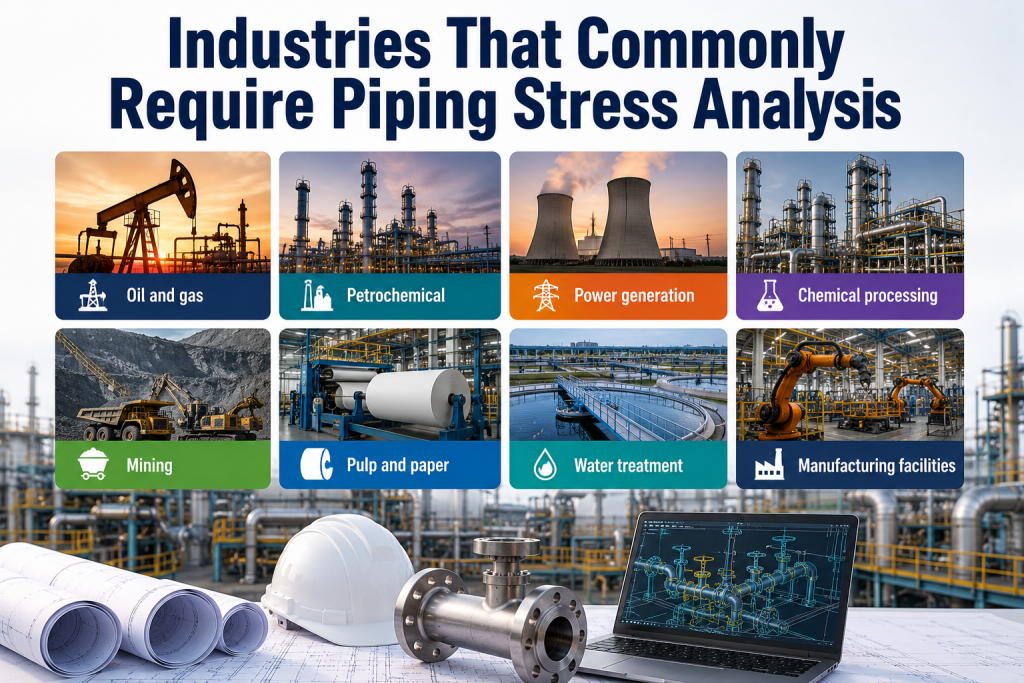 Stress analysis is commonly performed in:
Oil and gas
Petrochemical
Power generation
Chemical processing
Mining
Pulp and paper
Water treatment
Manufacturing facilities
Each industry has unique operating conditions and compliance requirements that influence the level of analysis needed.
How MECS Engineering Supports Piping Projects
MECS Engineering provides engineering support for industrial piping and pressure equipment projects across Canada and international markets.
Our services include:
Piping design
Pressure vessel engineering
FEA studies
CRN support
Mechanical engineering consulting
Code compliance reviews
P.Eng-reviewed calculations
We work with clients to develop practical, code-compliant solutions that support safe and reliable plant operation.
Conclusion
Piping stress analysis becomes essential whenever a system is exposed to temperature changes, pressure loads, vibration, equipment interaction, or significant modifications. Identifying potential issues early can help reduce project risks, improve reliability, and support compliance with applicable regulations.
MECS Engineering provides practical piping stress analysis and engineering support for industrial projects across Canada, helping clients achieve safe, efficient, and compliant system designs.
