
Why Professional Engineering Consultants Are Essential for Industrial Projects

Why Professional Engineering Consultants Are Essential for Industrial Projects Industrial projects require more than technical calculations and design drawings. They demand practical engineering expertise, regulatory awareness, and solutions that support safe, reliable, and efficient operations. This is where Professional Engineering Consultants play a critical role. Whether developing a new facility, modifying existing equipment, or preparing documentation for regulatory approvals, organizations often rely on experienced engineering consultants to guide projects from concept through execution. For businesses operating in Canada, the USA, and international markets, working with qualified engineering professionals can help reduce project risks and improve overall outcomes. What Do Professional Engineering Consultants Do? Professional Engineering Consultants provide technical expertise and advisory services across a wide range of engineering disciplines. Their role is to help clients solve engineering challenges while ensuring designs align with applicable standards, project requirements, and operational objectives. Services commonly include: Mechanical and piping design Piping stress analysis Structural engineering support Pressure equipment design review Technical calculations and documentation Regulatory compliance assessments Design registration support Professional Engineer review and stamping where required The specific scope varies depending on the industry, project complexity, and jurisdiction. Why Businesses Work with Professional Engineering Consultants Access to Specialized Expertise Many projects require technical knowledge that may not be available within an organization’s internal team. Engineering consultants bring experience from multiple industries and project types, helping clients address complex technical requirements efficiently. Improved Project Planning Engineering decisions made early in a project can affect safety, cost, constructability, and long-term maintenance. Consultants help identify potential challenges before they become costly problems. Support for Compliance Requirements Industrial projects often involve engineering codes, standards, and regulatory approvals. In Canada, some projects may require design registration, CRN support, or review by a licensed Professional Engineer. Requirements can vary by province, state, and local authority. Understanding these differences is important for successful project execution. Independent Technical Review Professional engineering consultants can provide objective assessments of designs, calculations, and project documentation, helping organizations make informed decisions. Key Services Provided by Professional Engineering Consultants Piping Design and Stress Analysis Piping systems are subject to pressure, temperature changes, equipment loads, and environmental forces. Proper design and stress analysis help ensure systems operate safely and reliably. Engineering reviews can identify areas requiring additional flexibility, support modifications, or routing improvements. Pressure Equipment Engineering Pressure vessels, heat exchangers, and related equipment require detailed engineering analysis and documentation. Consultants help verify compliance with applicable standards while supporting fabrication, installation, and regulatory approval processes. CRN Support and Design Registration Companies supplying pressure equipment to Canada often need assistance with Canadian Registration Number applications and supporting documentation. Professional consultants can help prepare calculations, review drawings, and coordinate registration submissions with the applicable authorities. Structural Engineering Support Industrial facilities rely on properly designed supports, platforms, and structural systems. Engineering analysis helps confirm these structures can safely handle operational and environmental loads. Choosing the Right Professional Engineering Consultants Not all consulting firms offer the same capabilities. When selecting a partner, consider several important factors. Industry Experience Consultants with experience in industrial projects often provide more practical recommendations and a stronger understanding of field conditions. Regulatory Knowledge Understanding local regulations and approval requirements is particularly important for projects involving pressure equipment, CRN registrations, or Professional Engineer authentication. Multidisciplinary Capabilities Projects often require coordination between mechanical, structural, piping, and fabrication disciplines. Firms that offer integrated services can improve efficiency and communication. Clear Communication Effective consultants provide organized documentation, practical recommendations, and timely responses throughout the project lifecycle. How MECS Supports Industrial Clients MECS provides professional engineering consulting services for industrial clients across Canada, the USA, and international markets. Our expertise includes: Piping design and engineering Piping stress analysis Pressure equipment engineering Structural analysis and support design CRN support and design registration Professional Engineer stamping where required Technical documentation and compliance support By combining technical expertise with practical industry experience, MECS helps clients address engineering challenges while supporting project goals and regulatory requirements. The Value of Professional Engineering Consultants Industrial projects involve numerous technical, operational, and regulatory considerations. Experienced consultants help organizations navigate these challenges with greater confidence. From concept development and detailed design to compliance support and technical review, professional engineering expertise can contribute to safer, more efficient, and more reliable project outcomes. Conclusion Professional Engineering Consultants play an important role in helping industrial projects achieve technical excellence, regulatory compliance, and operational reliability. Their expertise supports informed decision-making throughout every stage of a project. MECS provides practical engineering consulting services tailored to industrial clients in Canada, the USA, and around the world. Contact our team today to discuss how we can support your next engineering project.
P.Eng. Stamping for Pressure Equipment Projects: What Manufacturers and Engineering Teams Need to Know
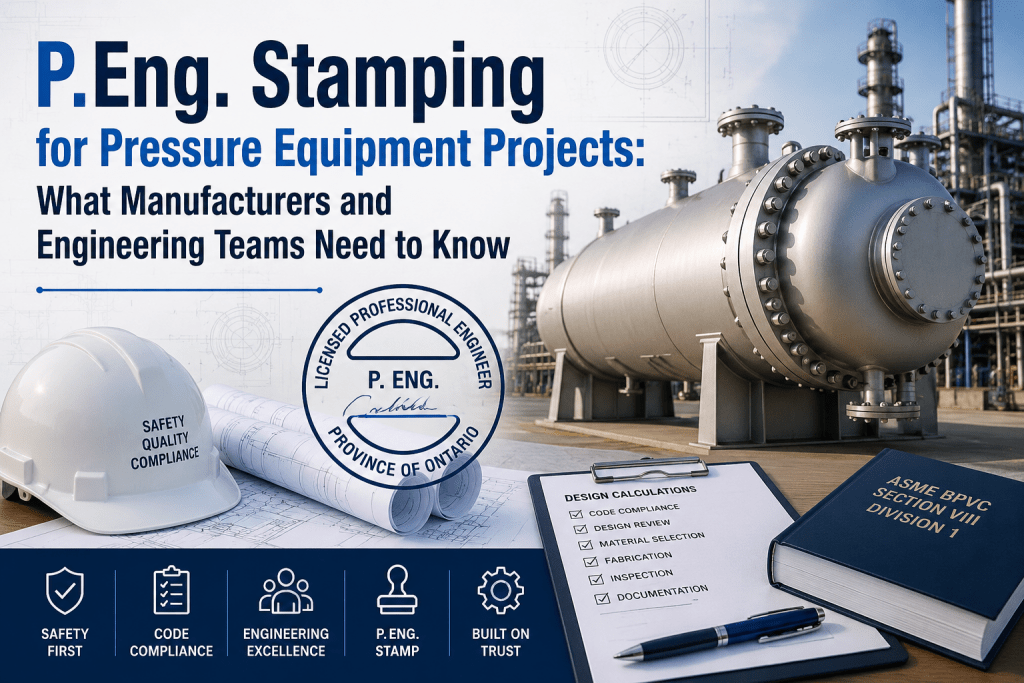
P.Eng. Stamping for Pressure Equipment Projects: What Manufacturers and Engineering Teams Need to Know In pressure equipment and industrial piping projects, engineering documentation is more than a technical formality. Design calculations, drawings, stress analysis reports, and code compliance documents often require review and authentication by a licensed Professional Engineer before they can be submitted to clients, authorities, or provincial regulators. For organizations involved in pressure vessels, piping systems, process plants, or CRN registration, understanding how P.Eng. stamping works are an important part of project planning and regulatory compliance. This article explains what P.Eng. stamping is, where it is commonly required, and how engineering firms support manufacturers, EPC contractors, and plant operators through the process. What Is P.Eng. Stamping? A P.Eng. stamp refers to the professional authentication of engineering work by a licensed Professional Engineer (P.Eng.). In Canada, Professional Engineers are regulated at the provincial level, and licensing requirements vary between jurisdictions. When an engineer applies their professional seal and signature to engineering documents, they are confirming that: The work has been reviewed under their professional responsibility The engineering complies with applicable codes and standards The design is suitable for its intended use within the defined scope Appropriate engineering judgment has been exercised For pressure equipment projects, stamped documentation may include: Pressure vessel design calculations Piping stress analysis reports Finite Element Analysis (FEA) reports Fabrication drawings CRN submission packages Structural support calculations Engineering design reviews Inspection and compliance documentation P.Eng. stamping is commonly associated with regulatory submissions, owner requirements, insurance compliance, and third-party engineering verification. Why P.Eng. Stamping Matters in Pressure Equipment Projects In industries such as oil and gas, petrochemical, power generation, chemical processing, and manufacturing, pressure equipment failures can create significant operational and safety risks. Engineering review and authentication help establish confidence that systems have been designed according to recognized engineering practices and applicable codes. A professionally reviewed design can also help organizations: Support CRN registration applications Demonstrate code compliance Meet client engineering specifications Reduce delays during regulatory review Improve documentation quality Address technical issues before fabrication or installation For many projects, stamped engineering documentation becomes part of the official project record and may be reviewed by regulators, inspectors, clients, or authorized inspection agencies. Where P.Eng. Stamping Is Commonly Required Requirements depend on the project scope, equipment type, province, client specifications, and applicable regulations. In practice, P.Eng. authentication is frequently requested for: Pressure Vessel Design Pressure vessel calculations prepared to ASME Section VIII requirements are often reviewed and stamped before submission for CRN registration or client approval. Typical examples include: Horizontal pressure vessels Vertical separators Heat exchangers Storage vessels Custom fabricated pressure equipment Piping System Design and Stress Analysis Industrial piping systems exposed to thermal expansion, vibration, pressure loading, or external forces may require engineering review and stress analysis. Stamped reports may include: Caesar II stress analysis Pipe support calculations Flexibility analysis Sustained and expansion load evaluations Nozzle load verification CRN Registration Packages Canadian Registration Number (CRN) submissions often require professionally prepared or reviewed documentation, depending on provincial requirements and project conditions. This may include: Design calculations Data reports Drawings Material specifications Code compliance documentation Because CRN processes vary between provinces, applicants should verify requirements with the applicable authority having jurisdiction. Understanding Provincial Requirements Engineering regulation and pressure equipment registration in Canada are administered provincially. Requirements can differ between jurisdictions, particularly regarding authentication expectations, submission procedures, and accepted documentation. Organizations commonly encounter regulators such as: Alberta Boilers Safety Association (ABSA) Technical Standards and Safety Authority (TSSA) Technical Safety BC Régie du bâtiment du Québec (RBQ) Project teams working across multiple provinces should ensure that submissions align with the requirements of each jurisdiction. For international manufacturers supplying equipment into Canada, this is often one of the more challenging aspects of the CRN process. Common Challenges in P.Eng. Stamping and Compliance Review Incomplete Design Documentation One of the most common issues during engineering review is incomplete supporting documentation. Examples include: Missing material traceability Incomplete nozzle load information Unverified external loads Missing code references Inconsistent drawing revisions These issues can delay CRN submissions and increase review cycles. Misalignment Between Design Codes and Project Requirements Projects sometimes combine multiple standards, client specifications, and jurisdictional requirements. Without careful coordination, this can create conflicts between: ASME code requirements Provincial expectations Owner specifications International design standards Early engineering review helps identify these issues before fabrication begins. Piping Flexibility and Thermal Expansion Concerns Thermal expansion remains a common source of piping design problems. Systems that appear acceptable in layout drawings may experience excessive loads, nozzle stress, or support issues during operation. Professional stress analysis and engineering review can help identify: Excessive displacement High nozzle loads Support overload conditions Expansion joint concerns Fatigue-related risks The Role of Third-Party Engineering Verification Independent engineering review is commonly used when: Manufacturers require Canadian compliance support Owners want additional technical verification EPC contractors need stamped calculations International suppliers are unfamiliar with CRN requirements Existing systems require reassessment or modification Third-party engineering firms may provide services such as: Pressure vessel calculations Piping stress analysis FEA review CRN preparation support Professional engineering authentication Code compliance assessments This type of support can help organizations streamline regulatory review and improve overall documentation quality. How MECS Supports Pressure Equipment Compliance Projects MECS Engineering provides engineering support for pressure equipment and industrial projects involving: Piping design and stress analysis Pressure vessel engineering CRN registration support FEA and structural review Professional engineering authentication Third-party verification services The company works with manufacturers, engineering contractors, fabricators, and industrial facilities across a range of sectors. For projects requiring independent engineering review and authentication, the Third-Party Verification Services page outlines available support for code compliance and engineering documentation review. Best Practices Before Submitting Documents for P.Eng. Review To improve review efficiency and reduce revision cycles, project teams should prepare: Complete Design Inputs Ensure that all operating conditions, design temperatures, pressures, and external loads are clearly defined before calculations begin. Updated Drawings and Revisions Drawings should match the latest calculation packages and fabrication details. Applicable Code References Clearly identify which editions of ASME,
Third Party Verification: Why It Matters in Industrial Engineering

Third Party Verification: Why It Matters in Industrial Engineering Industrial projects often involve strict technical requirements, regulatory expectations, and complex engineering documentation. Whether a project includes pressure equipment, piping systems, structural components, or fabrication packages, owners and contractors need confidence that designs and deliverables meet applicable standards. This is where Third Party Verification becomes valuable. Independent engineering review helps identify issues early, improve quality control, and support compliance with project specifications and regulatory requirements. For projects across Canada, the USA, and international markets, third party verification can provide an additional layer of technical assurance before equipment is installed or commissioned. What Is Third Party Verification? Third Party Verification is an independent engineering review performed by a qualified organization that is separate from the original designer, manufacturer, or contractor. The purpose of the review is to assess whether engineering documents, calculations, fabrication details, or designs align with applicable codes, standards, and project requirements. Verification may apply to: Pressure vessels Piping systems Structural supports Fabrication drawings Design calculations Stress analysis reports CRN application packages Quality and compliance documentation The level of review depends on the project scope and industry requirements. Why Third Party Verification Is Important Improves Engineering Confidence Independent review can help identify technical concerns, missing information, or inconsistencies before fabrication or installation begins. This helps project teams reduce the risk of costly revisions later in the project lifecycle. Supports Compliance Requirements Some projects require external review as part of regulatory, client, or insurance requirements. In Canada, pressure equipment projects may also involve provincial regulators and CRN-related review processes depending on the equipment type and jurisdiction. Requirements can vary by province, state, and local authority, so project-specific review obligations should always be confirmed. Helps Reduce Project Delays Incomplete calculations, drawing conflicts, or documentation gaps can slow approvals and fabrication schedules. Early verification often improves coordination between engineering, fabrication, and compliance teams. Provides Additional Quality Assurance Third party review supports consistency and accountability across engineering deliverables, especially on large or technically demanding projects. When Is Third Party Verification Commonly Used? Many industries rely on Third Party Verification during design, fabrication, or regulatory approval stages. Typical applications include: Pressure equipment manufacturing Industrial piping systems Oil and gas facilities Chemical processing plants Power generation projects Fabrication and modular skid packages CRN registration submissions Brownfield modifications and upgrades Verification is particularly useful when projects involve multiple contractors, international suppliers, or complex code requirements. What Does the Verification Process Include? The exact scope depends on the project, but the process often includes several technical review steps. Design Review Engineering calculations, material specifications, and drawings are checked against applicable standards and project requirements. Code Compliance Assessment Reviewers assess whether the design aligns with recognized codes such as ASME standards or relevant jurisdictional requirements. Documentation Verification Technical documentation is reviewed for completeness, consistency, and traceability. Comment Resolution Any identified concerns are documented so corrections or clarifications can be addressed before project completion. Third Party Verification in Canada and International Projects Canadian industrial projects may involve additional regulatory considerations, particularly for pressure equipment and CRN-related applications. Some projects also require review or authentication by a licensed Professional Engineer depending on local regulations. International manufacturers supplying equipment into Canada often benefit from third party engineering support because documentation expectations may differ from other jurisdictions. Since local regulations apply, verification requirements should always be reviewed according to the installation location and project scope. How MECS Supports Third Party Verification MECS provides practical Third Party Verification services for industrial clients across Canada, the USA, and global markets. Our engineering team supports projects involving: Pressure equipment review Piping and stress analysis verification CRN support documentation Structural engineering assessments Design calculation review Fabrication package verification Professional Engineer support where required MECS works closely with manufacturers, EPC contractors, fabricators, and facility owners to help improve technical accuracy and project readiness. Choosing the Right Verification Partner Effective verification requires both technical expertise and practical industry experience. The review team should understand engineering standards, fabrication practices, and real project constraints. Clear communication and organized reporting are also important to help project teams resolve issues efficiently. Conclusion Third Party Verification provides an important layer of technical review for industrial projects involving pressure equipment, piping systems, and engineering documentation. Independent assessment can help improve quality, support compliance, and reduce the risk of costly project delays. MECS offers third party verification and engineering support services tailored to industrial projects in Canada, the USA, and international markets. Contact our team to discuss your project requirements and verification needs.
Professional Engineering Consultants: What They Do and Why It Matters

Professional Engineering Consultants: What They Do and Why It Matters Professional engineering consultants play a critical role in delivering safe, compliant, and efficient engineering solutions. Whether you are developing industrial piping systems, pressure equipment, or complex mechanical designs, working with experienced consultants helps reduce risk and streamline approvals. This guide explains what professional engineering consultants do, how they support compliance, and what to look for when choosing the right partner. What Do Professional Engineering Consultants Do? Professional engineering consultants provide specialized expertise to support design, analysis, and regulatory compliance. Their work often includes: Design and Engineering Support They develop detailed engineering designs for systems such as piping networks, pressure vessels, and mechanical infrastructure. This includes material selection, layout planning, and system optimization. Stress Analysis and Safety Evaluation Consultants perform stress analysis to ensure systems can handle operational loads, temperature changes, and pressure conditions. This is especially important in industries where failure can lead to safety risks or downtime. Compliance and Regulatory Guidance Engineering consultants help navigate applicable codes and standards. Requirements can vary by province or state, so understanding local regulations is essential. Consultants ensure designs align with recognized codes and meet regulatory expectations. Design Registration and CRN Support For pressure equipment, design registration may be required. Consultants assist with documentation, calculations, and submissions needed for CRN approval. This process ensures the design meets safety and compliance standards before fabrication. P.Eng Stamping and Certification A licensed Professional Engineer reviews and stamps engineering documents where required. This confirms that the design meets applicable standards and has been evaluated by a qualified professional. Why Businesses Rely on Professional Engineering Consultants Many organizations engage professional engineering consultants to improve project outcomes and reduce compliance risks. Improved Project Efficiency Consultants bring established processes and technical knowledge, helping teams avoid delays caused by design revisions or regulatory issues. Reduced Compliance Risk Regulatory requirements can be complex and vary by jurisdiction. Consultants ensure documentation and designs meet the necessary standards from the start. Access to Specialized Expertise Not every company has in-house expertise for advanced analysis or design registration. Consultants provide targeted support without the need to build internal teams. Better Design Accuracy With experience in stress analysis and system design, consultants help ensure that engineering solutions are both practical and reliable. Key Areas of Engineering Consultancy Professional engineering consultants typically support multiple technical areas: Piping Design Efficient piping systems require careful planning and analysis. Consultants design systems that meet operational requirements while maintaining safety and compliance. Pressure Equipment Engineering Pressure vessels and related systems must meet strict standards. Consultants assist with design calculations, documentation, and registration processes. Mechanical System Design From industrial equipment to integrated systems, consultants provide design solutions tailored to specific project needs. Regulatory Documentation Preparing clear and accurate documentation is essential for approvals. Consultants ensure all required calculations, drawings, and reports are properly compiled. What to Look for in Professional Engineering Consultants Choosing the right consultant can significantly impact project success. Consider the following factors: Relevant Experience Look for consultants with proven experience in your industry and project type. Familiarity with similar systems improves efficiency and accuracy. Knowledge of Codes and Standards Ensure the team understands applicable codes and regulatory requirements. This is particularly important for projects requiring design registration or certification. Licensed Professional Engineers Verify that the consultant has access to licensed engineers who can review and stamp documents when required. Clear Communication Effective communication helps avoid misunderstandings and ensures smooth collaboration throughout the project lifecycle. How MECS Engineering Supports Your Projects At MECS Engineering, professional engineering consultants provide practical, compliance-focused solutions for complex engineering challenges. Services include piping design, stress analysis, CRN support, and P.Eng stamping. The team works closely with clients to understand project requirements and deliver designs that align with applicable standards. By focusing on accuracy and compliance, MECS helps reduce delays and support successful project outcomes. To learn more about available services, visit https://mecsengineering.com Conclusion Professional engineering consultants are essential for ensuring safe, compliant, and efficient project execution. From design and analysis to regulatory approvals and certification, their expertise supports every stage of the engineering process. If your project involves complex systems or requires regulatory approval, working with experienced consultants can help you move forward with confidence. Connect with a qualified team to ensure your designs meet both technical and compliance requirements.
Third Party Verification: Ensuring Reliable Engineering Compliance

Third Party Verification: Ensuring Reliable Engineering Compliance Introduction Third party verification plays a crucial role in engineering projects, particularly for piping, structural, and mechanical systems. It provides an independent review of designs, materials, and installation practices to ensure safety, quality, regulatory compliance and facilitate approvals with regulatory authorities. MECS offers professional third party verification services, including design reviews, inspection, and P.Eng stamping, helping clients meet provincial and state requirements efficiently. What Is Third Party Verification? Third party verification involves an independent organization reviewing engineering work to confirm compliance with applicable codes, standards, and project specifications. It ensures that systems meet safety and performance requirements without bias from the original design team. Key areas often verified include: Piping and structural design Pressure vessel compliance Welding and material inspections Installation and operational procedures By providing an objective assessment, third party verification helps identify potential issues early and avoids costly rework or safety concerns. Why Third Party Verification Matters Independent verification offers several advantages: Enhanced Safety: Confirms that designs and installations can withstand operational loads and environmental conditions. Regulatory Compliance: Ensures adherence to ASME, CSA, and local provincial or state codes. Requirements can vary, making verification essential for legal approval. Project Confidence: Gives stakeholders assurance that engineering work meets professional standards. Risk Mitigation: Identifies potential design flaws or material deficiencies before they impact project performance. Many engineering teams find that integrating third party verification early in the project lifecycle streamlines approvals and improves overall project quality. Key Considerations for Third Party Verification When planning third party verification, engineers should focus on: Scope of Review: Define which components, systems, or stages require independent verification. Standards and Codes: Confirm that all relevant codes are addressed, noting regional variations. Documentation: Provide clear design documents, drawings, and calculations for accurate assessment. Qualified Inspectors: Ensure verification is conducted by certified professionals familiar with P.Eng requirements and CRN processes where applicable. Proper planning ensures that verification adds value without unnecessary delays to the project timeline. How MECS Supports Third Party Verification MECS provides end-to-end third party verification services for engineering projects, including: Independent design review and stress analysis Inspection of piping, pressure vessels, and structural systems P.Eng stamping and CRN support for compliance Collaboration with project teams to meet regulatory requirements efficiently Our team ensures that every verification aligns with applicable codes and standards while helping clients maintain project timelines and quality benchmarks.
P.Eng. Stamping: What It Means for Engineering Compliance
P.Eng. Stamping: What It Means for Engineering Compliance In many engineering projects, accountability and compliance are essential. This is where P.Eng. Stamping becomes important. A stamp from a Professional Engineer (P.Eng.) confirms that engineering work has been reviewed and meets applicable standards and regulations. For companies involved in piping systems, pressure equipment, or industrial infrastructure, understanding how P.Eng. Stamping works can help avoid compliance issues and delays during project approvals. This article explains what P.Eng. Stamping involves, when it may be required, and how it supports safe and compliant engineering practices. What Is P.Eng. Stamping? P.Eng. Stamping refers to the official seal placed on engineering drawings, calculations, or technical documents by a licensed Professional Engineer. The stamp indicates that the engineer has reviewed the work and takes professional responsibility for its technical accuracy. In practice, this process confirms that: The engineering design follows accepted engineering principles Applicable codes and standards have been considered The design is suitable for its intended use A stamped document often becomes part of regulatory submissions, project approvals, or equipment registration processes. Why P.Eng. Stamping Matters in Engineering Projects Accountability and Professional Responsibility When a document receives a P.Eng. Stamp, the engineer is confirming that the design has been reviewed according to professional standards. This helps establish clear accountability within the project. Regulatory Compliance In many jurisdictions, regulators require engineering documents to be stamped by a Professional Engineer before construction, installation, or equipment registration.Requirements can vary by province, state, or country, so companies must confirm the rules that apply in their specific location. Project Approval and Permitting Stamped documents are often necessary during permitting or design registration processes. Without proper P.Eng. Stamping, regulatory authorities may reject submissions or request additional verification. Where P.Eng. Stamping Is Commonly Required Pressure Equipment and Piping Systems Design calculations, stress analysis reports, and piping drawings often require P.Eng. Stamping, especially when applying for CRN registration or design approval. Industrial Facility Design Engineering work related to processing plants, energy systems, and industrial equipment may require review and approval by a licensed engineer. Structural Engineering Structural supports, mechanical equipment installations, and load-bearing components frequently require professional verification through stamped documents. Because regulations differ across regions, organizations should verify the requirements set by their local provincial regulator or engineering authority. P.Eng. Stamping and Third-Party Verification In some cases, companies may seek independent review before submitting engineering documents to regulators. This process is commonly known as third-party verification. Independent verification can provide an additional level of technical review, especially for complex piping systems, pressure equipment, or specialized engineering designs. Services such as stress analysis, design validation, and regulatory support help ensure that engineering documentation meets applicable standards before the P.Eng. Stamping process is completed. Companies that require independent review can learn more about the process through third-party engineering verification services, which support compliance and documentation readiness. Partner with Specialized Engineering Consultants Engaging consulting firms that specialize in stress analysis, piping design, and regulatory filings can mitigate compliance risks and accelerate the overall process. Summary Ultimately, P.Eng. Stamping is vital for upholding professional and legal standards in engineering. This verification by a licensed Professional Engineer ensures that technical documents promote safety, accountability, and project compliance. As regulations are region-specific, it is essential for organizations to verify the particular rules governing their industry and location. For projects involving design registration, pressure equipment, or piping systems, collaborating with experts ensures your paperwork is accurately prepared for regulatory review and P.Eng. Stamping.
Why Professional Engineering Consultants Are Essential for Modern Engineering Projects

Why Professional Engineering Consultants Are Essential for Modern Engineering Projects Engineering projects in the modern era are characterized by increasingly strict safety standards, highly complex technical requirements, and detailed regulatory processes that vary significantly by jurisdiction. Whether a company is developing sophisticated industrial equipment, high-pressure systems, or intricate specialized piping networks, expert guidance is a fundamental requirement to ensure the work meets professional standards and maintains public safety. This is where Professional Engineering Consultants play a critical role as strategic partners. These consultants provide specialized, high-level expertise in conceptual design, detailed mechanical analysis, regulatory compliance, and final project validation. Their involvement helps companies move projects forward efficiently, reducing the likelihood of costly delays while ensuring that all engineering work strictly meets applicable codes and professional requirements. What Do Professional Engineering Consultants Do? Professional Engineering Consultants provide comprehensive technical and regulatory support for engineering projects across various industrial sectors. Their role is multifaceted, typically encompassing design validation, advanced engineering analysis, rigorous compliance reviews, and thorough documentation support to facilitate external audits or registrations. Key responsibilities often include: Engineering Design and Review Consultants meticulously evaluate engineering designs to ensure they align with international safety standards, engineering best practices, and specific regulatory expectations. This comprehensive review process may include evaluating the integrity of mechanical systems, checking the layout of complex piping networks, or verifying the specifications of pressure equipment designs before they reach the manufacturing stage. Stress Analysis and Technical Evaluation Many projects require detailed stress analysis to verify that components can safely handle operating loads, pressure, temperature changes, and other environmental factors. Professional consultants help perform these calculations and assessments. Regulatory Compliance Guidance Engineering projects frequently involve compliance with industry codes, standards, and provincial or state regulations. Professional Engineering Consultants help organizations understand what requirements apply and how to meet them. Professional Engineer Stamping Certain engineering documents may require approval or certification by a Professional Engineer (P.Eng) depending on the jurisdiction and project type. Consultants can assist with reviewing and stamping engineering documents where appropriate. Design Registration Support In some cases, pressure equipment or specialized mechanical systems require design registration before installation or manufacturing. Consultants can support companies through the documentation and technical review process. How MECS Engineering Supports Clients Engineering consulting firms like MECS Engineering provide practical support for organizations managing complex technical projects. Services typically include: Piping system design Engineering stress analysis Design verification and review CRN documentation support Professional Engineer stamping where applicable These services help companies maintain compliance, improve design reliability, and move projects through approval processes more efficiently. For organizations seeking experienced Professional Engineering Consultants, working with specialists such as MECS Engineering can provide valuable technical insight and regulatory guidance. Explore the services offered by Professional Engineering Consultants athttps://mecsengineering.com Choosing the Right Professional Engineering Consultants Selecting the right engineering consultant is an important step for any project involving regulated systems or specialized technical requirements. When evaluating consultants, companies often consider: Professional licensing and credentials Experience with relevant codes and standards Industry-specific expertise Ability to provide documentation and compliance support Clear communication throughout the project Working with knowledgeable consultants helps ensure engineering work is performed responsibly and in accordance with professional standards. Conclusion Engineering projects often require specialized knowledge, careful documentation, and compliance with technical regulations. Professional Engineering Consultants help organizations navigate these requirements while maintaining safe and effective engineering practices.
Third Party Verification and P.Eng./P.E. Professional Sealing: Ensuring Compliance and Quality

Third Party Verification and P.Eng./P.E. Professional Sealing: Ensuring Compliance and Quality Engineering projects succeed when designs are technically sound, safely executed, and aligned with the requirements of the authority having jurisdiction. In many industrial and commercial applications, an independent engineering review (often called third party verification) and P.Eng./P.E. professional sealing of documents provide confidence that critical technical decisions have been checked and that accountability is clear. What third party verification means in practice Third party verification is an independent review performed by an engineering professional or engineering firm that is not the original designer. The purpose is to confirm that the design intent, calculations, drawings, and assumptions are consistent with the applicable codes, standards, and project requirements. Depending on the project, third party verification may include: design review of mechanical or structural systems review of pressure equipment documentation for registration readiness piping stress analysis review for code compliance and support load checks confirmation that drawings and calculations are consistent (for example, design pressure, corrosion allowance, MDMT, materials, joint efficiencies, and load cases) constructability and “field risk” checks where small drawing gaps can become major site issues Independent review is especially valuable when: schedules are tight and rework is expensive equipment will be operated in regulated service multiple parties contribute to the design package (fabricator, EPC, client, and specialist vendors) the project will be submitted to provincial regulators Understanding P.Eng. professional sealing P.Eng. professional sealing (stamp and signature) indicates that a licensed Professional Engineer has taken responsibility for the engineering work within the sealed documents, consistent with their scope of review and professional obligations. It is not merely an administrative step. It is an accountability mechanism tied to public safety, engineering practice standards, and the engineer’s duty to perform work with appropriate competence and diligence. Professional sealing is commonly required or expected for documents used for: regulatory submissions permitting and authority review construction and installation owner records and operational control Because regulatory expectations can differ by jurisdiction, professional sealing should be applied with an understanding of the local submission pathway and how the authority evaluates the package. Jurisdictional expectations and CRN-related design review For pressure equipment and related systems, requirements often depend on where the equipment will be installed and how it is classified. In Canada, provincial regulators such as ABSA (Alberta) and TSSA (Ontario) may require registration, supporting calculations, and documentation that meets specific provincial expectations. For CRN-related submissions, third party verification often focuses on practical registration readiness, for example: confirming the design basis and code of construction are consistent across drawings, calculations, and datasheets checking that design pressure, temperature, corrosion allowance, materials, and MDMT are consistent and properly justified reviewing nozzle loads, support details, and applicable load cases ensuring the submission package includes the right documents, forms, and traceability CRN-related piping stress reviewsMany projects include pressure equipment along with pressure piping that requires stress evaluation under codes such as ASME B31.3 (as applicable to the system). A piping stress review commonly addresses: thermal expansion and restraint loads at equipment nozzles sustained, occasional, and displacement stress compliance support selection, guide/stop placement, and load paths to structure special cases such as steam systems, vibration risk, and transient events (as applicable) When done early, this prevents late-stage redesign, nozzle load exceedances, and regulator questions that can delay approvals. Why combine independent verification with professional sealing Independent verification and professional sealing together reduce risk in different but complementary ways: better technical confidence: a qualified reviewer can identify errors, missing cases, or inconsistent assumptions before fabrication or installation fewer compliance surprises: documents can be aligned with jurisdictional expectations before submission clearer accountability: sealing documents establishes professional responsibility for the work within the sealed scope stronger project outcomes: fewer RFIs, fewer site changes, and fewer schedule impacts from rework How MECS Engineering supports clients MECS Engineering supports industrial clients with independent engineering review and professional sealing for submissions and project documentation, including pressure equipment and piping-related deliverables. Our team regularly interfaces with provincial regulators such as ABSA and TSSA and helps clients prepare packages that are technically complete, consistent, and ready for review. Typical support includes: third party design verification and gap review of drawings and calculations CRN submission readiness checks and documentation coordination piping stress analysis and review support to address code compliance and equipment interface loads clear comment packages that identify what must change for compliance versus what is optional for design optimization Choosing the right engineering partner When selecting a firm for third party verification and professional sealing, look for: demonstrated experience with the relevant codes and the specific equipment type familiarity with jurisdictional expectations and regulator review patterns disciplined review methods that focus on safety, compliance, and constructible deliverables clear scope definition that matches what will be sealed and submitted Conclusion Third party verification and P.Eng. professional sealing help organizations deliver safer and more compliant engineering outcomes. Independent review reduces errors and rework, while sealing provides professional accountability for the engineering work within the sealed documents. With the right approach and the right partner, projects move through authority review more smoothly and reach operation with higher confidence.
Professional Engineering Services for Regulated Industrial Projects

Professional Engineering Services for Regulated Industrial Projects In today’s regulated industrial environment, engineering decisions directly affect safety, operability, cost, and regulatory approval. Professional engineering consultants play a critical role in bridging design intent, real-world operating conditions, and jurisdictional compliance. Their involvement is not optional for most industrial projects; it is fundamental to avoiding costly redesigns, schedule delays, and regulatory rework. Why Professional Engineering Consultants Matter Industrial projects increasingly involve pressure equipment, piping systems, rotating machinery, structural supports, and complex interfaces between disciplines. Each of these elements is governed by applicable codes, standards, and provincial or state regulations. Professional engineering consultants provide the technical authority and accountability required to ensure that systems are designed, reviewed, and executed correctly. Engaging licensed professional engineers reduces risk at multiple levels. From verifying design assumptions and load cases to confirming code compliance and documenting engineering judgment, consultants help owners and EPCs avoid failures that can lead to shutdowns, rejected submissions, or safety incidents. Regulatory expectations are not uniform. Requirements vary by jurisdiction, application, and equipment type. Consultants with direct experience working with authorities having jurisdiction understand how regulators review submissions and where common deficiencies occur. This practical regulatory insight is often as important as technical design capability. Core Industrial Engineering Services Professional industrial engineering services extend beyond conceptual advice. In practice, they involve detailed technical work, formal verification, and regulator-ready documentation. Typical services include: Process and system design support, including review of operating conditions, design bases, and interface requirements across disciplines. Equipment and system engineering, such as pressure vessels, heat exchangers, piping systems, skids, and associated structural supports, designed and reviewed to applicable ASME, CSA, and other governing codes. Piping stress and flexibility analysis to evaluate thermal expansion, sustained loads, occasional loads, nozzle loads, and support design, often required for both operational reliability and regulatory acceptance. Safety and compliance reviews, including identification of code gaps, verification of allowable stresses, material selection, corrosion allowances, and minimum design metal temperatures. Regulatory support and submissions, including preparation and review of documentation required for Canadian Registration Numbers (CRN), coordination with regulators, and technical responses to review comments. These services are not theoretical. They are executed with the expectation that the work will withstand regulatory scrutiny and professional liability obligations. How MECS Engineering Supports Industrial Projects MECS Engineering provides professional engineering consulting services focused on regulated industrial equipment and systems. The firm works extensively with pressure vessels, pressure piping, skids, and integrated industrial packages for clients across the world especially Canada and the United States. MECS engineers routinely support projects requiring compliance with ASME Section VIII, ASME B31 piping codes, CSA B51, and provincial regulatory requirements. The team has direct experience coordinating with regulators such as ABSA and TSSA and understands the practical expectations behind formal code clauses and application forms. For example, when supporting new equipment installations or retrofits, MECS scope typically includes engineering review of drawings and calculations, verification of design assumptions, confirmation of applicable code scope, and preparation of submission packages suitable for regulator review. This approach helps clients avoid delays caused by incomplete or misaligned submissions. MECS also supports EPCs and owners during regulator review cycles, addressing technical comments, clarifying design intent, and revising documentation as required to achieve approval efficiently. Choosing the Right Professional Engineering Services Provider Selecting a professional engineering services provider should be based on more than general experience. Owners and EPCs should assess licensing, jurisdictional familiarity, depth of regulatory experience, and the consultant’s ability to take responsibility for engineering decisions. A firm with demonstrated experience in regulated industrial projects brings practical value beyond calculations. That value lies in understanding how designs are reviewed, where regulators focus, and how to structure engineering work so that approvals are achieved without unnecessary iteration. Conclusion Professional engineering consulting is not simply a support function. It is a strategic component of successful industrial project execution. Reliable engineering services protect safety, ensure compliance, and reduce long-term operational and regulatory risk. MECS Engineering exemplifies this approach by combining technical depth with hands-on regulatory experience. By engaging professional engineering consultants who understand both engineering fundamentals and jurisdictional expectations, industrial clients can execute projects with confidence, efficiency, and accountability.
P.Eng. Certification/Stamping in Canada for Piping Projects: A Practical Guide
P.Eng. Certification/Stamping in Canada for Piping Projects: A Practical Guide If you work with piping systems in Canada, you’ve probably heard someone ask: “Do these drawings have a P.Eng stamp yet?” For many projects, that stamp is not just a formality. It’s a legal requirement and a key part of demonstrating that your design is safe, code-compliant, and reviewed by a licensed Professional Engineer. This guide explains what P.Eng stamping is, when you need it on piping projects, and how to prepare your design package so the stamping process is smooth instead of stressful. What is P.Eng. stamping? In Canada, a Professional Engineer (P.Eng) is licensed by a provincial or territorial regulator (such as PEO in Ontario or APEGA in Alberta). Their stamp or seal on a document means: The document contains engineering work. A licensed engineer has reviewed or prepared that work. That engineer is taking professional responsibility for the engineering content. In other words, the stamp is the engineer’s formal sign-off that the design meets applicable codes, standards, and regulatory expectations for safety and performance. When does a piping project need a P.Eng stamp? Each province and territory has its own legislation and practice guidelines, but in general, a P.Eng stamp is required when: The document is an engineering document (design, calculation, drawing, report, specification, etc.), and That document will be used by others to make decisions about construction, operation, or public safety. Typical piping-related documents that may need a P.Eng stamp include: Piping general arrangement (GA) drawings Piping isometrics for construction Pipe stress analysis reports Support design drawings and calculations Pressure design calculations (thickness, ratings, branch reinforcements, etc.) Design reports submitted to authorities or clients For pressure piping and pressure equipment, P.Eng stamping often goes hand-in-hand with Canadian Registration Number (CRN) or similar pressure equipment design registration. The stamp confirms professional responsibility; the registration confirms regulatory acceptance of the design. Important: The exact requirements vary by jurisdiction. Always check the rules for the province or territory where the equipment will be installed. Who can provide a P.Eng stamp? A P.Eng stamp can only be applied by: An engineer who holds a valid P.Eng licence in the province or territory where the project is located, and Is working within their area of competence (for example, piping / mechanical, not unrelated disciplines). In most provinces, if the engineering work is done as a business (consulting, design services, etc.), the company itself also needs: A Certificate of Authorization or Permit to Practice granting it the right to offer engineering services to the public. For owners and EPCs, this usually means one of two models: In-house P.Eng and Permit to Practice – your own engineering team stamps the documents. Specialist consulting firm – you outsource some or all of the piping design and have an external firm with the right licenses and permits review and stamp the work. How to prepare a “stamp-ready” piping package? A smooth stamping process starts long before the engineer picks up their seal. The more complete and clear your package is, the faster and more predictable the review becomes. At minimum, make sure you have: Clear design basis Design codes (e.g., ASME B31.1 / B31.3, etc.) Design pressures and temperatures Fluid properties and service category Load cases (thermal, weight, wind, seismic, occasional loads, etc.) Up-to-date drawings P&IDs, line list, and tie-in points Piping GAs and isometrics with consistent line numbers Equipment data sheets and nozzle loads Engineering calculations Pipe stress analysis reports (with load combinations and code compliance checks) Pipe wall thickness and rating checks Support design and structural checks where needed Nozzle load checks against equipment limits Materials and specifications Piping class / material specifications Weld details, inspection requirements, NDE levels Insulation, heat tracing, and coating requirements (if applicable) Safety and compliance notes Any identified special hazards Applicable regulatory or client specifications A P.Eng review is not just a quick stamp on the cover sheet. The engineer must be able to trace design decisions back to basis-of-design, codes, and calculations. Common pitfalls in P.Eng stamping for piping projects Here are issues that frequently cause delays or rework: Incomplete or inconsistent documentation Line lists don’t match P&IDs. Isometrics are missing or not coordinated with the stress model. Loads allowable by the vessel vendors don’t match the final stress analysis. “Stamp at the last minute” approach Documents are issued for construction and only then sent for stamping. Any changes required by the P.Eng become expensive and disruptive. Ignoring pressure equipment registration Assuming that “we have a P.Eng stamp, so Piping Registration (CRN) isn’t needed” in provinces where registration is mandatory for certain piping and equipment. For regulated pressure piping, you usually need both properly stamped documents and design registration with the relevant safety authority. Best practices to make stamping straightforward Engage a P.Eng earlyInvolve the reviewing engineer when you define the design basis and major assumptions, not after everything is frozen. Align on codes and scope upfrontGet written agreement on: Applicable codes and standards What exactly the P.Eng is taking responsibility for (which drawings, which calculations, which systems) Use standard templates and checklistsInternal or consultant-provided checklists for stress reports, drawings, and design notes reduce “back and forth” and catch issues before formal review. Track revisions and approvalsMaintain a clear revision history showing which versions were reviewed and stamped. Avoid multiple, conflicting “final” versions in circulation. FAQs about P.Eng stamping for piping projects What is a P.Eng stamp, in simple terms?It is a professional engineer’s seal, signature, and date on an engineering document, indicating that a licensed engineer has taken professional responsibility for the engineering content. Is P.Eng stamping mandatory for every piping project?Not for every single document, but many designs that affect public safety, pressure equipment, or are submitted to regulators, municipalities, or clients must be stamped under the applicable provincial engineering act. When in doubt, consult a licensed engineer in that jurisdiction. Does a P.Eng stamp replace CRN or pressure equipment registration?No. For regulated pressure equipment and piping, you typically need both: Engineering documents prepared/reviewed and stamped by a P.Eng, and Design registration (such as CRN) with the appropriate safety authority. How long does the stamping process take?It depends on the quality and completeness of the package.
